
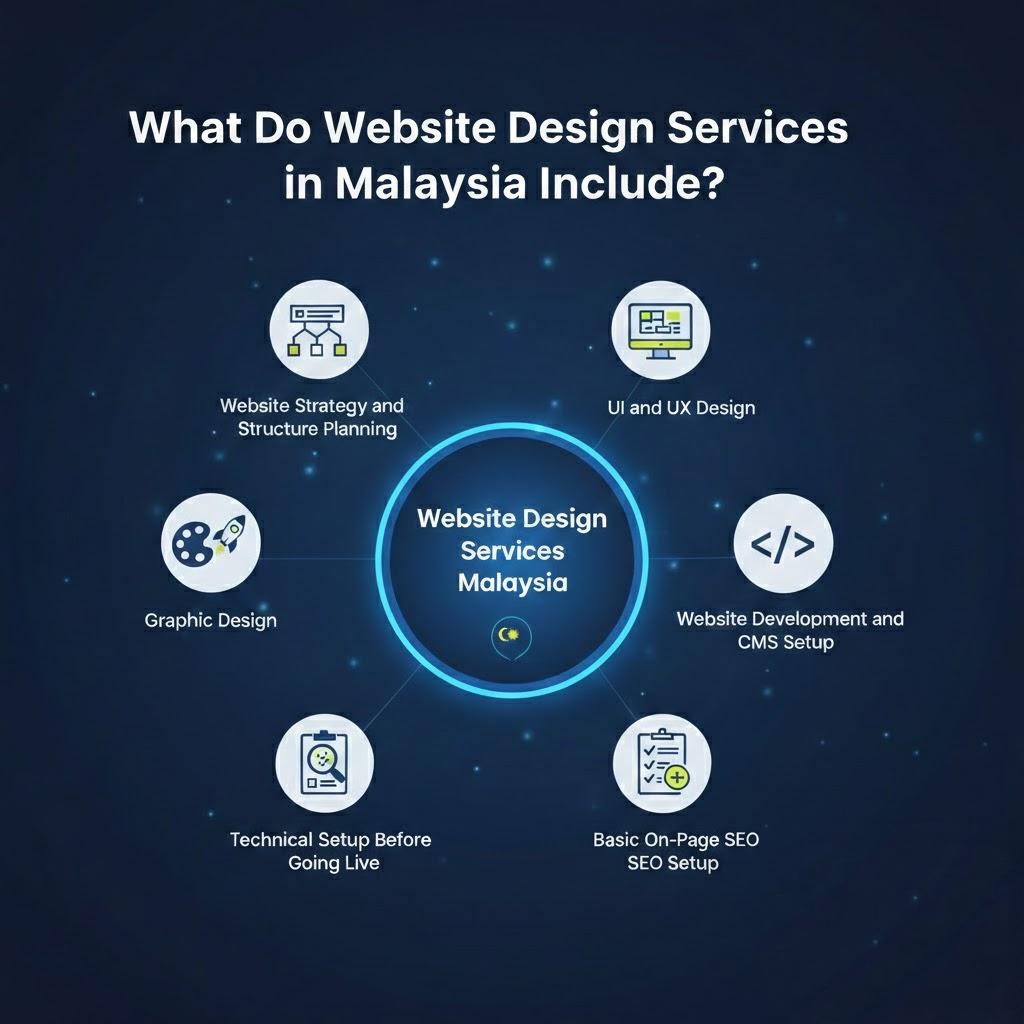

What Do Website Design Services in Malaysia Usually Include?
Website design services in Malaysia usually cover more than just how a site looks on screen. Depending on the provider, the scope may include:
- Website structure and page planning
- Content organisation and layout setup
- User flow and navigation planning
- Technical preparation for desktop and mobile launch
These elements determine how visitors navigate the site, how enquiries are generated, and how easily the website can be managed over time. Because not all providers include the same work under “website design,” understanding what is actually covered helps explain why pricing and deliverables can differ significantly.
Why Website Design Prices Vary
Website design services often come with very different scopes, which explains why businesses receive a wide range of quotes for what seems like a similar project. Some providers focus mainly on visual layout and basic page setup, while others include structure planning, content organisation, user flow, and technical preparation as part of the build.
When these differences are not clearly explained, it becomes difficult for business owners to compare options or understand what they are paying for, especially when looking up website design price malaysia without knowing what is actually included behind the quote. For a clearer look at how these factors affect pricing in real terms, you can read this guide on How Much Does a Website Costs in Malaysia? to understand general costs and what influences them.
What Is Included in Website Design Services in Malaysia?
1. Website Strategy and Structure Planning
Before any design work begins, a proper website build starts with planning how the site is structured and how users move through it. A professional web design company approaches this stage by defining how information is organised, how pages connect, and how visitors are guided toward meaningful actions. Skipping proper structure planning is one of the most common website design mistakes businesses make, often leading to confusing navigation and poor user experience. This groundwork supports usability, clear navigation, and smoother site management over time.
Key elements typically include:
- Page hierarchy and how information is grouped
- Navigation logic that keeps important pages easy to find
- User journey mapping based on how visitors are expected to interact with the site
- Conversion goals such as enquiries, lead forms, or booking actions
This planning ensures the website is visually organised and structured in a way that supports clarity, user intent, and measurable business outcomes.
2. UI and UX Design
UI and UX design focus on how users interact with a website. In website design Malaysia projects, this stage determines if visitors can read content comfortably, find what they need quickly, and complete actions easily. A visually attractive site may catch attention, but usability is what keeps users engaged and moving forward.
This stage typically covers:
- Layout planning to guide attention and reduce clutter
- Mobile responsiveness to ensure the site works smoothly across devices
- Readability and spacing to improve content consumption
- CTA placement that encourages enquiries or next-step actions
The difference between a “pretty” website and a usable one lies in how easily users can navigate, understand information, and take action without confusion or extra effort.
3. Website Development and CMS Setup
Website development is where design concepts are translated into a working site that can be managed, updated, and scaled. In all of our website design KL projects, this stage often determines how stable the site is, how easily content can be updated, and how well the platform supports future changes.
A website design company will handle the setup of the content management system, ensuring the site structure, templates, and core functions are built with long-term use in mind. The CMS choice also affects how flexible your website will be long-term, so it helps to find out which is better for your business.
Read our blog on “Which is better for your business? WordPress or Custom CMS” to understand the differences before deciding.
This stage often includes:
- WordPress or CMS setup based on project needs
- Theme-based builds or custom development for specific requirements
- Performance and stability considerations to support consistent site operation
Proper development and CMS setup ensure the website remains reliable, manageable, and adaptable as business needs evolve.
4. Content Integration
Content integration focuses on how existing content is placed and structured within the website. A professional web design company handles this stage to ensure pages are laid out clearly, information is easy to scan, and content works well within the overall site structure. This helps maintain consistency across pages and avoids issues that affect readability or user flow.
This stage typically includes:
- Page content placement based on layout and hierarchy
- Formatting for headings, paragraphs, and sections
- Basic on-page structure to support clarity and navigation
- Content migration if the website is being revamped
Content integration does not usually include content writing, copy optimisation, or ongoing content updates. Its purpose is to ensure that provided content is presented correctly and functions smoothly within the website framework.
5. Basic On-Page SEO Setup
Basic on-page SEO setup focuses on preparing the website so search engines can understand its structure and content correctly. This stage is not about rankings or ongoing optimisation, but about setting a proper foundation during the build so the site is technically sound and easy to index from day one.
This setup usually includes:
- Page titles and meta descriptions for key pages
- Clean URL structure that reflects page hierarchy
- Proper heading hierarchy to organise content clearly
- Image optimisation basics such as file naming and sizing
Proper on-page structure is one reason professional website design improves long-term ROI, as it supports better visibility, usability, and future optimisation without requiring major rework later on.
6. Technical Setup Before Going Live
Technical setup focuses on making sure the website functions properly before it is made public. This stage ensures the site loads correctly, works across common devices and browsers, and is stable enough for real users. Issues missed here often lead to post-launch fixes that increase time and cost, which can affect overall website design price malaysia expectations.
This stage usually includes:
- Mobile optimisation to ensure consistent performance across screen sizes
- Speed basics to support faster loading and smoother interaction
- Browser compatibility checks across commonly used browsers
- Basic security setup to protect the site at launch
- Live deployment to move the website from staging to production
Proper technical setup helps reduce early issues, supports user experience from day one, and avoids unnecessary rework after the site goes live.
What Website Design Services Usually Do Not Cover
Website design services focus on building and preparing a website for launch. The following areas are typically outside the standard scope and are handled as separate services, phases, or specialised projects.
1. Marketing and Growth Activities
- Advanced SEO campaigns, including ongoing keyword research, content expansion, backlink building, and ranking monitoring
- Content marketing strategies and editorial planning
- Ongoing blog writing, landing page copy, or campaign content creation
- Paid advertising setup or management for Google Ads, Meta Ads, or other platforms
- Social media strategy, posting schedules, and account management
- Influencer marketing or outreach campaigns
- Email marketing campaigns, newsletters, and drip sequences
2. Sales, CRM, and Automation Systems
- CRM platform setup and configuration
- Sales pipeline design and lead scoring systems
- Marketing automation workflows and follow-up sequences
- WhatsApp, chatbot, or live chat automation
- Integration with third-party sales tools or customer databases
3. Technical Development Beyond Website Scope
- Custom web applications or software-level development
- Large-scale custom integrations with ERP, accounting, or inventory systems
- Membership portals, learning platforms, or subscription systems
- Marketplace or multi-vendor platform development
- Advanced e-commerce logic such as custom pricing rules or fulfilment workflows
4. Content and Brand Assets
- Brand strategy, brand positioning, or messaging frameworks
- Logo design, visual identity systems, or brand guideline development
- Professional photography, videography, or copywriting services
- Translation or multilingual content creation
5. Data, Analytics, and Optimisation
- Advanced analytics setup, dashboards, or custom reporting
- Conversion rate optimisation testing and experiments
- User behaviour analysis or heatmap tracking
- Ongoing performance audits and optimisation
6. Hosting, Maintenance, and Operations
- Web hosting services or server administration
- Domain registration and management
- Ongoing website maintenance and updates after launch
- Security monitoring, backups, and uptime management
- Technical support beyond the agreed launch period
By separating these areas from the core website design scope, businesses gain clearer control over timelines, costs, and priorities. Additional services can still be planned as follow-up phases once the website foundation is in place.
How Service Scope Influences Website Cost
Website cost is shaped more by what is included in the build than by the final page count. Two websites with the same number of pages can require very different levels of work depending on how the site is planned, built, and prepared for use. This is why comparing quotes without understanding scope often leads to confusion, especially when working with a professional web design company that prices based on deliverables, not assumptions.
Key cost drivers commonly include:
| Custom features, conditional logic, or specialised user flows |
| Different layouts required for different page types |
| Custom layouts, interactions, or non-standard design elements |
| Multi-level navigation, nested pages, or complex site hierarchy |
| Mapping how users move through the site and take action |
| Custom fields, roles, or content management setup |
| Performance optimisation, browser compatibility, or device support |
| Forms, maps, analytics, or third-party tools |
| Time spent refining design and structure during feedback cycles |
| Moving content, media, or data from an existing website |
Focusing only on page count can be misleading. Website cost is determined by the depth and complexity of work involved, not simply by how many pages appear in the final build.
Conclusion
A well-built website begins with clear structure and defined scope. When planning is done properly, decisions around design, development, and future updates become more straightforward and easier to manage over time. Understanding what is included in website design services helps set realistic expectations before cost becomes the main consideration.
At Grayscale360, website projects are approached with attention to structure, usability, and long-term practicality. Each build is planned to support real business requirements, with clarity around scope and deliverables from the start.
If you are reviewing website options and want to better understand how structure and scope apply to your situation, contact us to discuss before moving into the next steps.
FAQs
1. What is usually included in website design services in Malaysia?
Website design services in Malaysia typically include planning the site structure, designing layouts, setting up the content management system, preparing pages for mobile and desktop use, and handling basic on-page setup. The focus is on building a functional and structured website that is ready to launch, rather than ongoing marketing or content creation.
2. Why do website design prices differ so much between companies?
Website design prices differ because the scope of work varies between providers. Factors such as project complexity, number of unique page templates, level of customisation, and technical requirements all affect the final cost. Two websites with similar page counts can require very different levels of work behind the scenes.
3. Does website design include SEO?
Website design usually includes basic on-page SEO setup, such as page titles, heading structure, clean URLs, and image optimisation. It does not normally include ongoing SEO campaigns, content expansion, or ranking improvement strategies, which are handled as separate services.
4. Is content writing included in website design services?
Content writing is not typically included in website design services. Website design focuses on integrating and structuring content that is provided, ensuring it is displayed clearly and consistently. Copywriting, blog creation, and ongoing content updates are usually scoped separately.
5. How do I know how much website design work my business actually needs?
The best way to determine this is to review your business goals, content requirements, and technical needs before comparing prices. Understanding the scope of work, such as structure planning, CMS setup, and level of customisation, provides a clearer picture of what is required and helps avoid unnecessary features or costs.